
Guest post by Nilamadhab Mishra.

Small businesses invest time and money to attract enquiries. Prospective customers may contact them through website forms, WhatsApp, phone calls, social media, or referrals. Yet an enquiry does not automatically become a sale.
The gap often appears after the enquiry arrives. Details are recorded in different places, employees are unsure who should respond, follow-up dates are missed, and managers cannot see which opportunities need attention. A low-cost lead follow-up workflow can bring these activities together. AI can assist with routine drafting and organisation, while employees remain responsible for customer decisions and communication.
This article uses a fictional Indian coaching centre to explain how a small business can start with familiar tools, introduce automation gradually, and maintain management oversight.
1. Start with the Business Problem
ABC Coaching Centre offers Data Analytics, Spoken English, Banking Examination, and Digital Marketing courses. It receives enquiries through a website, WhatsApp, and telephone calls. Two employees handle enquiries alongside their other duties.
A website enquiry may be recorded in an email inbox. A WhatsApp conversation remains on an employee’s phone. A telephone enquiry may be written in a notebook. If an employee is absent, another person may not know what was discussed or when to follow up.
The result is an incomplete picture. Some enquiries receive no response, some are contacted twice, and others are forgotten. The first objective is simple: every enquiry must enter one shared process, have a responsible owner, and show a clear next action.
2. Capture Enquiries in One Place
For a small business starting out, Google Forms can provide a simple enquiry form. Questions might include the person’s name, preferred contact method, course or service of interest, preferred time to be contacted, and a short description of the requirement. Form responses can be stored in Google Sheets, which becomes the starting point for the central lead register.
The form should collect only information the business needs. It should explain how the information will be used and provide an appropriate privacy notice. A form submission should also trigger an acknowledgement email where this has been configured. That message confirms receipt; it is not the actual sales response. Before relying on the form, test it all the way to the first reply.
Not every enquiry will arrive through the form. Staff must enter WhatsApp, telephone, social media, and referral enquiries into the same register. If the business later connects other channels through integrations, it should test that records are created correctly and not duplicated.
3. Build a Practical Lead Register
A spreadsheet can act as a basic CRM-style register before the business invests in a dedicated customer relationship management system (CRM). CRM means a system used to organise customer details, interactions, and sales opportunities.
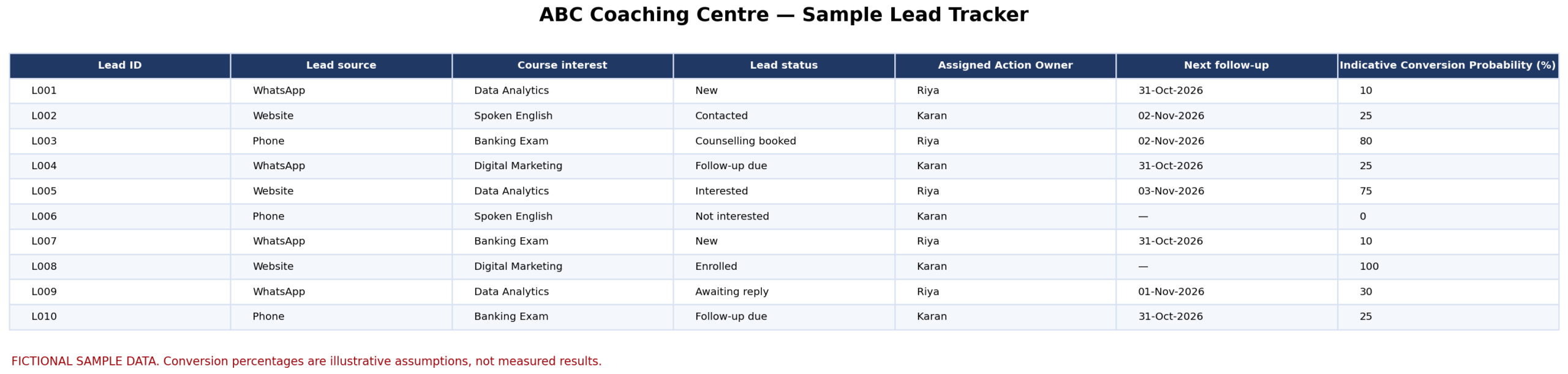
Each enquiry should receive a unique Lead ID. Useful fields include enquiry date, source, contact label or name, requirement, lead status, assigned action owner, last contact, next follow-up date, next action, contact permission, and indicative conversion probability.
The assigned action owner is the employee responsible for the next step. It is not necessarily the business owner. The register should also retain a short interaction history so another authorised employee can understand what has happened.
Lead status should describe the current position, such as New, Contacted, Awaiting reply, Follow-up due, Counselling booked, Interested, Enrolled, or Not interested. The status is updated after each meaningful interaction.
Prevent Duplicate and Missing Records
Before creating a new record, staff should search using an agreed identifier, such as a phone number or email address. If the same person has enquired through two channels, update the existing record and add the new source and interaction. Do not simply delete one record: preserve the history and resolve conflicting details.
Missing records need a separate daily control. At an agreed time, the action owner or supervisor should compare the central register with the source records: Google Form responses, WhatsApp business conversations, call logs, social media inboxes, and any paper notes. Every genuine enquiry should either be added to the register or documented as a duplicate, spam, or out-of-scope contact. The check should record who completed it and when. This reconciliation is important because automation cannot manage an enquiry it never receives.
4. Set Response and Follow-Up Rules
A business should define its own response service-level target. For the coaching-centre example, management might commit to an initial human response within one business day. Business hours and holidays should be clearly defined. The target should be realistic for the team’s capacity and communicated honestly.
A form acknowledgement can be sent immediately after submission, thanking the person and confirming that the enquiry has been received. It should state when the team expects to respond, without implying that a staff member has already reviewed the request. The assigned employee should receive a task or notification to make the actual response within the target.
Follow-up timing should follow company policy and the customer’s preference. For example, management may define when the first follow-up is due after course details are shared, how many attempts are appropriate, and when an enquiry should be marked inactive. The schedule should not encourage repeated unwanted messages. Record each attempt, the result, and the next agreed action.
5. Use AI with Human Approval
AI can help draft a reply using approved course information. For example, a prospective student asks for details about a Data Analytics course. The AI assistant can prepare a draft that acknowledges the enquiry, summarises verified course details, and asks whether the person would prefer a call or written information.
The employee must review the draft before sending it. They should check course fees, duration, batch availability, eligibility, and any claims about placements. AI must not invent discounts, guarantee jobs, or make commitments that the business has not approved.
The workflow can then create a reminder for the assigned employee and update the lead record after the message is sent. More advanced automation may connect forms, spreadsheets, email, a CRM, and messaging tools. These integrations require configuration, access permissions, testing, and may involve subscription costs. A spreadsheet by itself does not automatically send WhatsApp messages or manage every channel.
6. Qualify Leads and Involve a Subject-Matter Expert
A lead’s status and conversion probability should be updated as conversations develop. A simple fixed percentage for each status can be misleading. Someone marked Interested may have no budget or may be comparing several providers. Another person may have a specific requirement and be ready to make a decision after speaking with an expert.
The action owner should record relevant qualification information, such as the customer’s requirement, urgency, budget where appropriate, decision timeline, questions, and level of interest. If the enquiry needs specialist knowledge, the owner can assign or escalate it to a subject-matter expert. The handover should include the enquiry history and the question that needs answering, so the customer does not have to repeat everything.
The probability estimate can then be revised using the new information and, over time, the business’s own historical conversion data. For a new business without enough history, use clearly labelled provisional estimates rather than presenting percentages as facts.
7. Give Management a Useful View
Management needs more than a list of names. A simple view can show enquiries received by source, leads awaiting a response, the share answered within the one-business-day target, overdue follow-ups and leads by stage. To connect these numbers to bookings and revenue each week, see our weekly GA4-to-sales scorecard.
These views help management ask better questions. If website enquiries are not progressing, is the form unclear, is the response too slow, or are the enquiries poorly matched to the course? If many leads reach counselling but few enrol, do counsellors need better course information or objection-handling support? Management can review call or conversation themes where lawful and appropriate, using anonymised information and suitable access controls. It can then improve website content, enquiry questions, response templates, staff training, or course explanations.
8. Keep Cost and ROI Proportionate
Start by comparing the time spent on manual lead administration with the cost of setup, subscriptions, integrations, and maintenance. Record any change in staff time and business outcomes during a pilot. Do not assume that time saved automatically becomes additional revenue, and do not count the same benefit twice.
9. Protect Customer Information and Use WhatsApp Responsibly
A customer sending an enquiry is not blanket permission for ongoing promotional messages. Record the channel, purpose, date, and source of relevant permission. Explain what communications the person is agreeing to receive, respect opt-outs, and follow the applicable WhatsApp Business rules for the type of message being sent. A response to a customer’s request and later promotional messages may have different requirements. In India, the Digital Personal Data Protection Act, 2023 (DPDP Act) also sets rules for how businesses collect and use personal data, so keep consent records clear and use enquiry details only for the purpose the person agreed to.
Restrict access to lead records to authorised staff. Avoid putting unnecessary personal information into AI tools, and check how a tool stores and uses submitted data. Keep a process for correcting records and handling requests to stop contact. The business should review its privacy obligations and the terms of the platforms it uses.
A Practical Starting Checklist
- Choose one central lead register and define the required fields.
- Test the enquiry form and acknowledgement email.
- Assign an action owner to every new enquiry.
- Set a realistic initial-response target and define business hours.
- Agree follow-up timelines and limits under company policy.
- Reconcile source channels daily to find missing or duplicate records.
- Use approved information for AI-generated drafts and require human review.
- Define when a lead should be escalated to a subject-matter expert.
- Give management a view of response performance, overdue actions, and outcomes.
- Pilot the process with a small team, correct problems, and expand gradually.
Conclusion
A small business does not need to automate everything at once. It needs a reliable way to capture every enquiry, assign responsibility, respond within a clear timeframe, and make the next action visible. A form and spreadsheet can establish the foundation. AI can assist with drafting, reminders can support consistency, and management reporting can reveal where the process needs improvement.
Start with the process, test it with real operating conditions, protect customer preferences, and add integrations only when they solve a demonstrated problem. The value of AI follow-up is not the number of tools used. It is whether the business handles each genuine enquiry more consistently and responsibly.
Related reading on SyncNeck: how to test a lead form all the way to the first reply, a weekly GA4-to-sales scorecard and how to use AI to reply to Google reviews. Want help setting up your follow-up workflow? Contact the SyncNeck team.
AI assistance: the author used AI tools to help with outlining, drafting and language refinement, then reviewed and edited the article and is responsible for the final content. The coaching-centre example and tracker records are fictional.
About the author

Nilamadhab Mishra has over two decades of experience in finance, business operations, performance management, and learning and development. He is an Oracle Cloud Infrastructure 2025 Certified AI Foundations Associate and has completed Google Generative AI Leader training. Through Scalex, he explores practical digital marketing and AI automation solutions for businesses.