
Guest post by Furkan Esen.
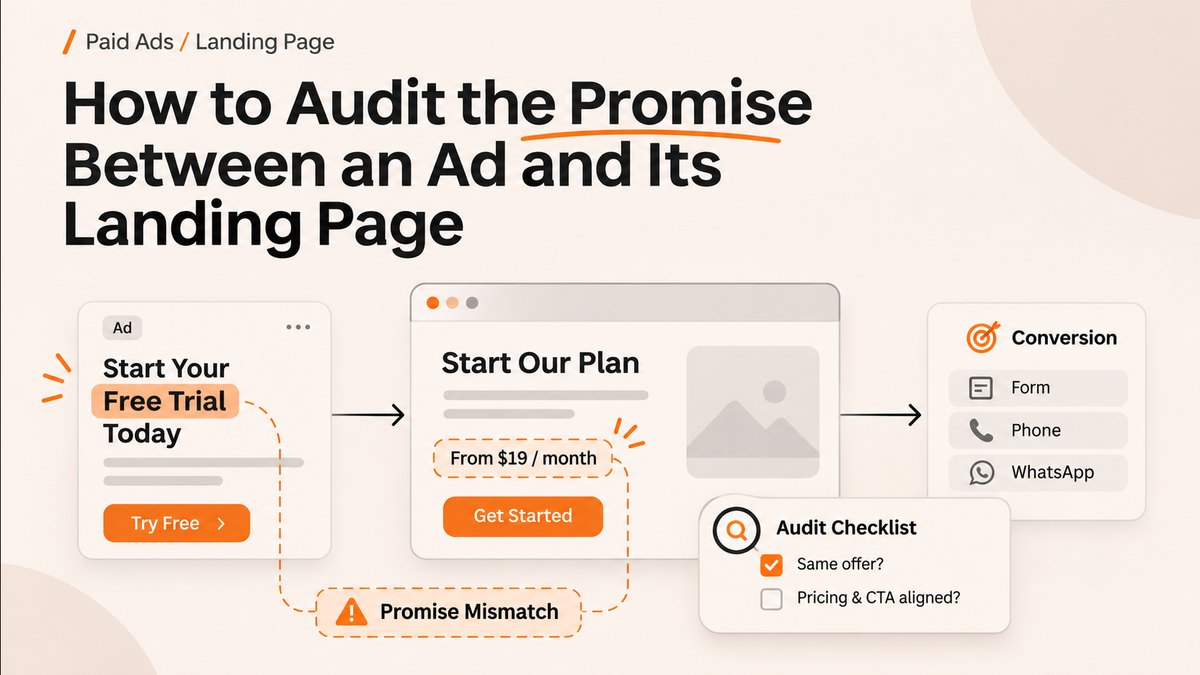
To audit the promise between an ad and its landing page, first define the business goal, the intended audience, and the action the ad promises. Then follow the visitor’s journey to see whether the page supports that promise. Avoid changing copy or design until you understand what is actually wrong.
A business may launch a Google Ads campaign, receive clicks, and struggle to generate enquiries. The immediate reaction is often to rewrite the headline or shorten the form. But perhaps the wrong people are clicking. Perhaps the offer is unclear. Or perhaps the business is counting submissions instead of qualified enquiries.
My starting questions are simple: What is the goal, how long has the campaign run, and what is happening now? An audit should connect the ad, the landing-page experience, and the next meaningful business outcome.
1. What Does It Mean for an Ad and a Landing Page to Match?
Message matching does not mean repeating the same headline word for word. It means that visitors can recognise the offer they clicked on and understand how to act on it.
Imagine a dental clinic in India running a Google Search ad: “Book a consultation about dental implants.” Someone searching for treatment clicks, expecting details about consultations and a way to request one. Instead, the destination is a general homepage describing every dental service and the clinic’s history.
The consultation may exist somewhere on the website, but the visitor must look for it. That is a potential mismatch. A focused destination would explain the consultation, who it is for, and how to request it.
This dental-clinic scenario is illustrative, not a measured campaign. It shows what to investigate, not proof that a mismatch caused lost bookings. For an introduction to campaigns and conversion goals, SyncNeck’s beginner’s PPC guide is a useful starting point.
2. Before Reviewing the Page, Understand the Campaign
A landing page cannot be judged apart from the offer and the people seeing the advertisement. Start by establishing the desired business result, the target audience, the offer, the campaign’s duration, and its recent performance.
Suppose an ad receives 100 clicks and no form submissions. Is that automatically a failure? Not necessarily. For a low-cost consumer product, it may warrant immediate investigation. For a specialised service costing several lakh rupees, the buying process may be longer and the expected number of qualified prospects smaller.
First define conversion. Does it mean a form submission, a useful enquiry, a qualified sales meeting, or a paying customer? Those outcomes are not interchangeable.
Also inspect who is arriving. A company selling a professional service might attract visitors who want to learn that skill rather than hire someone. Changing the landing-page headline cannot repair every targeting issue.
Look at the search terms available in the account, the intended audience, and the ad’s wording. Decide whether the problem lies in who was reached, what was promised, or what happened after the click.
3. What Exactly Did the Advertisement Promise?
Consider the phrase “Free Consultation.” It sounds attractive, but what consultation? Is it genuinely free? Are there conditions? What happens when someone requests it?
Not every detail belongs inside an ad. The landing page, however, should resolve the questions that matter before someone commits. A clinic might explain whether the consultation is a discussion of options, an examination, or an initial call.
During a review of a veterinary clinic’s advertising journey, I saw a more direct problem. The advertisement promoted free online appointment booking. Clicking it led to an About Us page introducing the founder. There was no functioning online booking system.
The first issue was not the colour of the button or the typography. The promised action was unavailable. This is an anonymised real-world observation; I cannot infer visitor abandonment or financial losses from it.
Follow the exact promise of the ad. If it offers an appointment, try to book one. If it promotes a free trial, try to start it. That simple check often reveals a problem more important than a cosmetic redesign.
4. Does the Landing Page Support the Same Offer?
A general website can introduce a business, its team, and its services. A campaign-specific landing page normally has a narrower job: help the right visitor evaluate and act on a particular offer.
Check the headline first. Does it identify the offer? Can the visitor understand what is included, who it is for, and what happens next? Is the primary call-to-action consistent with the ad?
I am especially cautious about unnecessary navigation, unrelated promotions, automatic entrance pop-ups, four or five competing CTAs, and long introductory copy that delays the offer. These can create friction, but the answer is not to remove every detail. A complex, high-value service may require substantial evidence, explanations, and reassurance.
Google’s own landing-page optimisation guidance advises advertisers to align the landing page with the ad, make the next action easy to find, and avoid excessive clutter.
For Search campaigns, Google also lists landing page experience as a component of Quality Score. Importantly, Quality Score is a diagnostic measure, not an input to the ad auction. It should not be used to promise a specific ranking, placement, or cost improvement after a page edit.
The useful question remains: does each page element help visitors make the decision this campaign asks them to make?
5. Can Visitors Take the Next Step Comfortably?
Open the destination on a phone and follow the journey yourself. Is the offer clear? Is the next action visible? Can someone complete it without broken steps, difficult fields, or intrusive overlays?
For some local businesses in India, the appropriate next step is a phone call or WhatsApp message, not a form. A clinic might accept appointment requests by phone; a coaching centre may answer admissions questions through WhatsApp. Those actions can count as conversions when they match the campaign goal and can be tracked meaningfully.
Form length also depends on the business. A B2B provider may intentionally ask about company size, needs, or budget to qualify prospects before a sales conversation. A consumer social app might ask for very little during sign-up. Both can be reasonable.
Do not shorten a form simply to raise submission totals. Nor should you make every visitor answer questions that the business does not need. Choose fields according to the offer, audience, and follow-up process.
Finally, test the full action, not just the button. A click on “Book” is not the same thing as a confirmed request or scheduled appointment.
6. What Should You Check in Your Campaign Data?
Begin with measurement: do successful forms, relevant calls, or appointment requests register correctly? Are they reaching the business team? Has the campaign run long enough for a useful assessment?
For longer sales cycles, I prefer cost per qualified lead, cost per qualified meeting, and customer acquisition cost (CAC) over raw lead counts alone. A campaign with fewer but more suitable enquiries may serve the business better than one producing many irrelevant submissions.
Google Analytics recommends distinct lead-generation events, including generate_lead and qualify_lead, in its GA4 event documentation. That distinction reinforces why a submission and a qualified opportunity should not automatically be treated as the same outcome.
For the basics of reading reports, see SyncNeck’s web analytics guide. To check that a form actually reaches your team, see how to test a lead form all the way to the first reply. To connect enquiries to real sales, see a weekly GA4-to-sales scorecard for local service businesses.
7. How Do You Turn the Audit Into an Action Plan?
Imagine finding unclear targeting, a confusing offer page, and missing tracking. Changing everything at once without documenting the issues makes it harder to understand what improved.
My preference is to clarify the offer and intended audience first. If a campaign is actively spending money on a seriously broken journey, I would consider pausing it. Then I would fix the landing page’s ability to deliver the offer, establish reliable conversion tracking, and relaunch or optimise the advertising with a clearer measurement plan.
This does not mean pausing every campaign because a page could be improved. The decision depends on risk, current spend, evidence, and the severity of the problem.
Use a short worksheet to make the audit actionable:
| Check | Question |
|---|---|
| Goal | Which business outcome are we trying to achieve? |
| Audience | Are the right people reaching the offer? |
| Promise | What does the advertisement lead them to expect? |
| Page | Is the same offer explained and available? |
| Action | Can visitors complete a form, call, or WhatsApp request? |
| Tracking | Are completed and qualified actions measured reliably? |
| Priority | What needs investigation or repair first? |
Record observations separately from conclusions. “The booking button leads to an About Us page” is an observable issue. “That page cost the business 30 customers” is not a defensible conclusion without supporting data.
After fixing an issue, repeat the journey and verify the repair. Evaluate business impact separately, using appropriate data rather than assuming every design change caused an improvement.
A useful audit begins with the business goal, audience, and offer, not a generic redesign checklist. It checks whether the promised action is actually possible and whether meaningful outcomes can be measured.
The aim is not always more leads. It is to help the right people take the right action.
Related reading on SyncNeck: how to test a lead form all the way to the first reply, a weekly GA4-to-sales scorecard and our beginner’s guide to PPC. Want a second pair of eyes on your ad journey? Contact the SyncNeck team.
AI assistance: the author used AI tools to help with structuring, drafting, editing and the featured illustration, then read and reviewed the full article and is responsible for its content. The veterinary-clinic observation is a real, anonymised example supplied by the author; the dental-clinic scenario is illustrative.
About the author

Furkan Esen is the co-founder of Avexra Digital, working across website development, SEO, digital advertising and conversion-focused web experiences. His approach connects campaign strategy, user experience and measurable business outcomes.