
Guest post by Anthony May. Edited by the SyncNeck team.
Most local service businesses have two different versions of their marketing performance. Google Analytics 4 shows visits and actions on the website. The booking diary and sales records show what happened after someone made contact. When those numbers are treated as the same thing, a campaign with plenty of clicks can appear successful even when very little paid work follows.
A weekly scorecard does not require a new platform. It requires clear definitions, a consistent reporting period and a few numbers from the systems the business already uses. The point is to see where enquiries turn into booked appointments and where they stop.
1. Why GA4 and sales records rarely match
GA4 measures website and app events. It does not automatically know whether a phone call was answered, whether a WhatsApp enquiry was genuine, or whether an appointment resulted in a paid job. A visitor can submit a form twice. A staff member can test a contact button. A person can click to call and then hang up. Those actions should not all become separate sales leads.
At the same time, a real enquiry may arrive by phone, walk-in or direct message without a reliable website event. Consent settings, tracking blockers and incomplete tagging can also leave gaps. A difference between GA4 and the booking diary is not automatically a software error. It is a prompt to check what each system is counting.
Use GA4 to understand digital activity. Use the business’s own records to verify enquiries, bookings and completed work. Do not claim the second set of results came from the first unless you can connect them with evidence.
2. Pick one reporting period and define each stage
Choose a fixed week, such as Monday through Sunday, and record the dates at the top of the sheet. Give each stage a precise meaning before collecting figures.
Marketing spend is the cost attributed to the campaigns being reviewed. Tracked enquiry events are form submissions, relevant click events and other contact signals; they are not necessarily distinct people. Unique enquiries are distinct real prospects after removing repeat messages, test entries and obvious spam. Qualified enquiries fit the service, location and basic purchase requirements. Booked visits are confirmed appointments, not promises to call back. Completed jobs are delivered and paid work, not estimates or pending appointments.
Assign ownership. One person exports GA4 and ad-platform totals. Someone handling calls or WhatsApp checks unique and qualified enquiries. The booking team confirms appointments. Accounts or the job system confirms paid work. If a field cannot be verified, mark it unknown instead of filling it with a guess.
A lead that arrives on Sunday may become a paid job next week. Keep the original enquiry date and the eventual outcome date. This prevents the weekly report from treating unfinished leads as permanent failures.
3. Export the small set of numbers from GA4 and ad platforms
Start with source, medium, campaign and relevant events in GA4, then add spend from the advertising platform or invoices. Google calls important business actions “key events” in GA4. You can mark a collected event as a key event, but that label does not turn it into a confirmed sale.
WhatsApp deserves special attention for Indian local businesses. If a website button opens a WhatsApp link on another domain, GA4 enhanced measurement can record the outbound click when configured appropriately. Check the link URL and event in GA4 or DebugView. A WhatsApp click is not proof that a conversation started, that a person was qualified, or that a booking was made. Confirm those outcomes in the message and booking records.
Similarly, a click on a phone link is not necessarily a connected call. A form event is not necessarily a valid enquiry. Check whether a tag fires more than once and whether some enquiries bypass the website entirely.
Campaign attribution is imperfect. A customer may see an advert, search the company name later and finally send a WhatsApp message. If the source is unclear, keep it as unknown. A smaller reliable number is more useful than a precise-looking number built on assumptions.
4. Reconcile with the appointment and sales log
Create one row per real enquiry in a working log. Record the date, channel when known, service requested, qualification status, booking status and eventual outcome. Use a permitted internal reference to match records. Do not place patient information, sensitive notes or unnecessary personal details in a shared marketing sheet.
Deduplicate carefully. The same person may call, submit a form and send a WhatsApp message. Those are three contact actions but usually one prospect. Check the phone or email where appropriate, while following the business’s privacy rules.
Mark unanswered calls and unreturned messages separately. They can reveal a follow-up problem rather than an advertising problem. Our guide on testing a lead form all the way to the first reply shows how to find these gaps. Record appointments that were cancelled or rescheduled instead of silently counting them as completed jobs.
I saw this first hand with a business whose website numbers looked healthy while its actual bookings were much lower. The advertising was not the problem. The staff handling enquiries were upset, and customers who got in touch felt uneasy and decided not to book. Once we found the cause, the team was retrained with customer service as the first priority.
Do not force every row into a source. Some records will be unassigned. Report the unassigned count, and improve tagging or intake questions next week. Never distribute unattributed jobs across channels merely to make a report balance.
5. Walk through a fictional weekly scorecard
Consider a hypothetical home-service business in India. These numbers are invented for illustration. They are not an actual company’s performance.
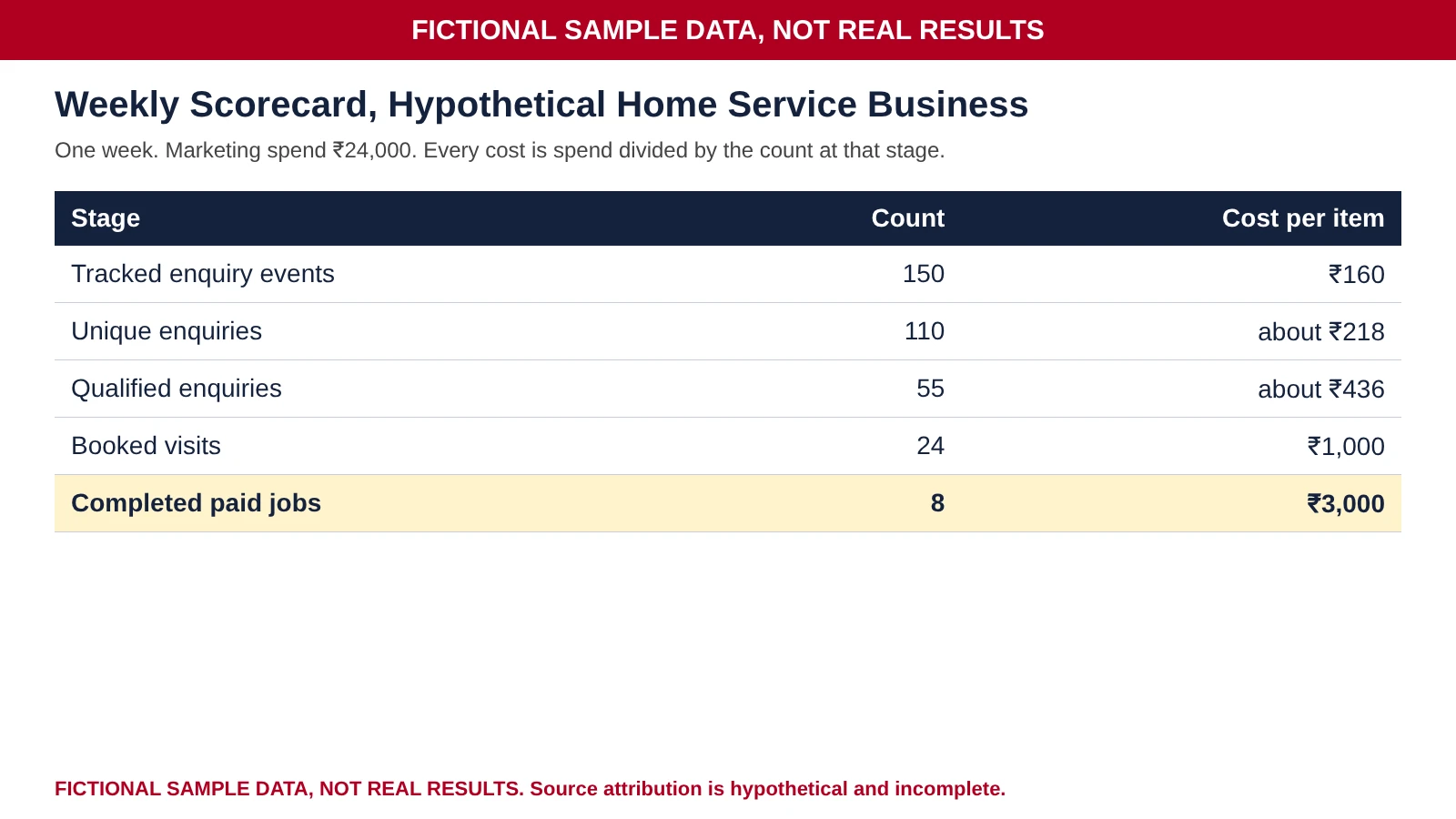
The calculation is the same at each stage: divide ₹24,000 by the count at that stage. A report showing ₹160 per tracked event may sound attractive. But the illustrative business spent ₹3,000 for each completed job. Those are different questions, and both figures matter.
Now examine the losses. Forty of the 150 events did not represent additional real enquiries. Only half the unique enquiries qualified. Fewer than half of the qualified enquiries became booked visits. Eight of the 24 visits became completed paid jobs.
Each drop suggests a different investigation. Repeated or irrelevant enquiries point toward targeting, form design or tracking quality. Qualified enquiries that never book suggest response time, phone coverage or scheduling friction. Visits that do not turn into jobs call for a look at estimates, availability, pricing and customer expectations. The sheet identifies where to investigate; it does not prove the cause.
6. Adapt the scorecard for clinics and coaching centres
The same structure works outside home services, but the final stage must fit the business.
A clinic might track enquiries, suitable appointment requests, confirmed consultations and attended consultations. Attendance is not the same as revenue, and patient details should not appear in the shared marketing report. A coaching centre might track enquiries, qualified applicants, counselling sessions and paid enrolments. An application is not a paid student.
For either business, decide whether the main outcome is a booked appointment, attendance or collected payment. Use that definition consistently. If the business sells repeat services, add a separate longer-term view rather than mixing lifetime value into the weekly lead count.
The goal is not to make every industry use the same sales label. It is to keep a verified chain from the first contact to the outcome the business cares about.
7. Run a 20-minute weekly review
Use the first five minutes to check data quality: missing campaigns, duplicate events, unattributed enquiries and records without an outcome. Spend the next five minutes comparing the stages with the previous few weeks. Then review the biggest drop and assign one practical fix. Finish by naming the person responsible and the date the change will be checked.
For example, if many qualified WhatsApp enquiries go unanswered, test a response-time rule before increasing ad spend. If bookings are healthy but completed jobs are low, inspect the estimate and appointment process. If a campaign generates cheap events but very few qualified enquiries, review targeting and messaging.
Do not declare a channel profitable because one week’s cost per job looks low. Jobs can close after the reporting period, and different sources may share credit for the same customer. Look across several weeks and separate verified source matches from unknown attribution.
A useful weekly scorecard does not need to be complicated. It needs honest definitions and consistent follow-through. When GA4 activity and the sales diary are reviewed together, the business gets a clearer view of what to fix before buying more traffic.
Related reading on SyncNeck: how to test a lead form all the way to the first reply, how to track AI traffic in GA4 and Search Console’s new multimodal filter. Want help setting up your scorecard? Contact the SyncNeck team.
AI assistance: the author used an AI assistant to help draft and edit this article, then reviewed it and checked the GA4 claims against Google’s documentation.
About the author

Anthony May has more than 25 years of experience in SEO, paid media and performance reporting, including legal and local service marketing. He runs Marketing Tool Kit, which makes practical marketing measurement resources for businesses and agencies.