Guest post by Dr. Gleb Tsipursky. Edited by the SyncNeck team.
An AI tool can write a marketing draft in seconds and still leave you with more work than before. To find out whether it helps, record the time you once spent on the task, then subtract the minutes spent prompting, checking, and fixing the AI version. The difference is your real time saving.
For a small business owner or solo marketer in India, a simple spreadsheet can settle this question in a month. Call it the AI Search Rework Ledger. It works for blog posts, product descriptions, social captions, search snippets, and other repeatable marketing tasks. You do not need special software or an accounting background.
What Should You Put in the Ledger?
Start with one row for each completed task. Record six things: the task, how long it normally takes without AI, how long the AI draft takes, how long you spend checking it, how long you spend fixing it, and the net minutes saved. If you want to estimate the value of that time, add your hourly rate and the AI cost assigned to the task.
Keep the units simple. Record every time in minutes, your hourly rate in rupees, and your AI cost in rupees. Do not mix an hourly estimate with daily totals or put the monthly subscription fee into every row.
The calculation is:
Net minutes saved = time before AI − AI drafting time − checking time − fixing time.
Estimated time value = net minutes saved ÷ 60 × hourly rate.
Estimated net benefit = estimated time value − AI cost assigned to that task.
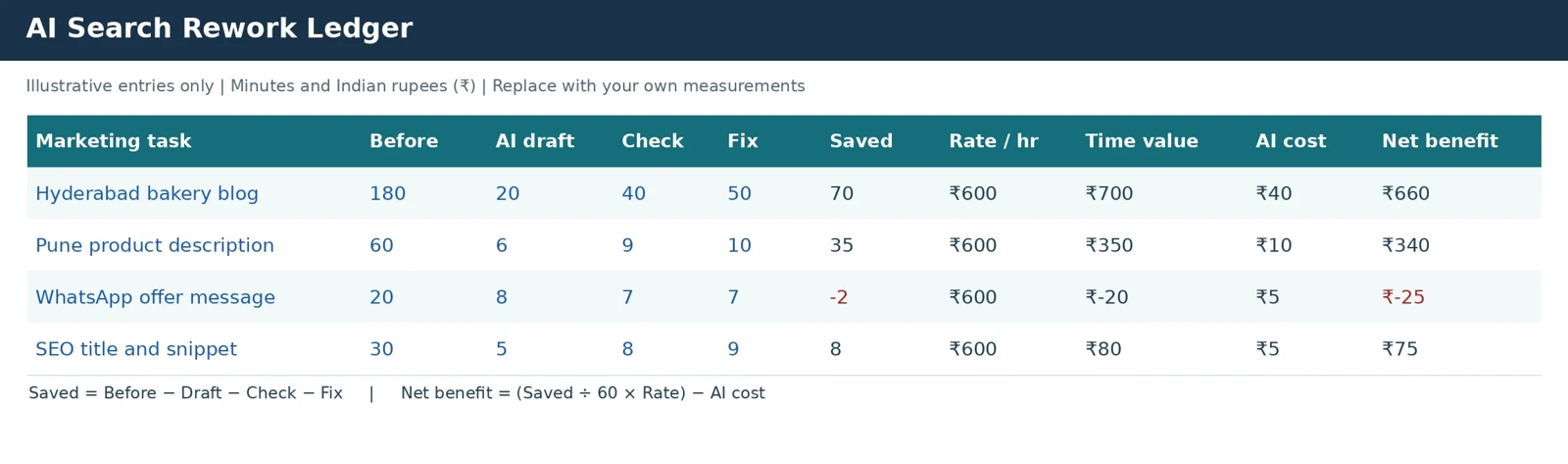
Suppose your normal process takes 60 minutes. An AI-assisted version takes six minutes to draft, nine to check, and ten to correct. The finished job uses 25 minutes, so you saved 35 minutes. At a working-time value of ₹600 per hour, that is ₹350 of capacity. If the AI cost assigned to the task is ₹10, the estimated net benefit is ₹340.
The ₹350 is not automatically extra cash in your bank account. It measures the value of time you can use elsewhere. It becomes a financial gain when that time replaces paid work, lets you serve another customer, or supports some other result you can track.
How Do You Find a Fair Before-AI Time?
Choose a task that you already do. Use the time from a recent completed job without AI, or time your next manual attempt. If one blog post takes two hours and another takes five, compare work of similar length and difficulty. A short description for a familiar product should not be measured against an unfamiliar technical product.
Write down what “finished” means before you start. For a blog post, it might mean 900 words, clear headings, verified claims, one local example, and a version ready for your website. For a product description, it might mean the correct size, price, materials, delivery information, and tone. Keep that standard the same for manual and AI-assisted work.
Use a timer, but do not obsess over seconds. Five-minute increments are enough at first. Include the time required to write prompts, gather information, move text between tools, inspect the result, and make final edits. If your AI draft looks complete after five minutes but still requires an hour of rewriting, that hour belongs in the ledger.
Worked Example 1: A Hyderabad Bakery’s Blog Post
Imagine a bakery owner preparing a blog post about ordering birthday cakes in Hyderabad. Without AI, a finished post takes 180 minutes. The owner uses AI for a first draft and spends 20 minutes preparing the request and producing usable text. Checking the product details, local references, and links takes 40 minutes. Reworking stiff passages and adding accurate delivery information takes another 50.
The ledger says 180 − 20 − 40 − 50 = 70 minutes saved. At ₹600 per hour, those 70 minutes have an estimated value of ₹700. Assign ₹40 of AI expense to this job, and the net benefit becomes ₹660.
That number is useful, even though most of the job happened after the draft appeared. The bakery owner now knows that the process saved 70 minutes rather than the tempting but false 160-minute figure calculated by comparing the old time with drafting time alone.
The owner should still decide whether the post meets the same publishing standard. SyncNeck’s separate guide to testing AI writing tools covers that quality question. The ledger focuses on the effort and cost needed to finish the work. A low-quality final result should never count as a successful time saving.
Worked Example 2: A Pune Seller’s Product Description
Now imagine a solo marketer writing a product page for a Pune shop selling handmade desk organizers. A manual description takes 60 minutes. Preparing the AI request and draft takes six minutes. Checking measurements, material names, and product availability takes nine. Editing the language takes ten more. The marketer saves 35 minutes.
At the same ₹600 hourly rate, the time value is ₹350. With ₹10 of AI expense allocated to the job, the estimated net benefit is ₹340. The marketer can repeat this process across similar products, while checking every product’s specific facts against the shop’s own catalogue.
Compare a quick WhatsApp promotion that normally takes 20 minutes. In an illustrative trial, drafting takes eight minutes, checking seven, and fixing seven. The AI process takes 22 minutes. It loses two minutes and incurs ₹5 of assigned AI cost, leaving a negative estimated benefit of ₹25. Drafting a tiny message manually may be easier.
One profitable task does not mean every marketing task should use AI. The winning unit is the completed task, with its own baseline, checking time, and error costs.
What Does a Filled-In Ledger Look Like?
The screenshot below shows four sample tasks with their time and cost figures. All figures are hypothetical teaching examples, not measured results from the businesses described. The accompanying Excel template uses formulas to calculate saved minutes, estimated time value, and net benefit. Replace the sample figures with your own work.
How Do You Record AI Costs Without Double Counting?
If you pay per request, enter the approximate cost of that request. If you pay a fixed subscription and use it across 30 comparable work tasks in a month, one simple approach is to divide the monthly fee by those 30 tasks. For example, a ₹900 subscription spread across 30 tasks gives an allocated cost of ₹30 per task.
That allocation is a planning choice. If you already pay the subscription for unrelated work, the extra cost of one more request may be close to zero. Pick a method, write it at the top of your ledger, and use it consistently. Otherwise, a change in accounting method may look like a change in AI performance.
Your hourly rate is also an assumption. A freelancer might use the rate normally charged for comparable work. An owner might use the value of an hour reserved for serving customers. Avoid declaring all saved time to be revenue. Keep a separate note of whether the minutes were actually used for billable work, reduced contractor spending, or simply freed up the day.
What Should You Track During a 30-Day Trial?
Start with three tasks you repeat. For a small shop, these could be product descriptions, short promotional messages, and weekly posts. For a solo marketer, try client blog drafts, search titles and descriptions, and email copy. Run each task enough times to expose slow cases, not just a demonstration that went well.
For every run, enter the time immediately after finishing. At the end of each week, look at the average saved minutes for each task, the worst result, and how many times the output required substantial corrections. Also note whether the AI tool got easier to use or whether a new kind of task introduced fresh rework.
Suppose the bakery blog example occurs twice in a month and the product description twelve times. If those illustrative per-task results remained stable, the estimated net benefits would be ₹1,320 and ₹4,080 respectively. That is a projection from example figures, not a prediction. Your actual totals may differ substantially, especially on the first few attempts.
When Is a Task Worth Automating?
Use a short rule: continue an AI-assisted task when it repeatedly saves time after checking and corrections, and consider further automation only when it is repeatable, the net benefit stays positive, and a person can verify the finished output before it goes live.
For a first decision, compare at least three or four real runs of the same task. If one run saves 35 minutes, another saves five, and two lose time, improve the instructions or return to the manual process before automating it. If every run saves 25 to 35 minutes with manageable checking, it deserves another look.
Automating the next step could be as modest as saving a reusable prompt, collecting product facts in a standard form, or setting up a repeatable handoff to a reviewer. You do not have to connect a publishing tool directly to your website. In a one-person business, even a reliable checklist can prevent rework without creating a complicated system.
Keep human checking for prices, availability, dates, customer promises, and material claims. Put those checks in the task itself so the ledger reflects the real process you will use each week.
What Mistakes Make the Ledger Misleading?
The first is counting draft speed as total savings. The second is using a generous manual baseline for one example and a much easier AI task for comparison. The third is ignoring the time spent repairing a factual or tone problem. A fourth is counting the same subscription cost twice, once in each row and again as a monthly deduction.
A fast draft is pleasant. A consistently faster finished job is the reason to keep using the tool. After 30 days, the ledger should tell you which marketing tasks earned their place in your workflow and which ones still demand too much rework.
Related reading on SyncNeck: how to test AI writing tools for your blog, which Gemini suggestions in Google Ads to accept and how to track AI traffic in GA4. Want help setting up your own ledger? Contact the SyncNeck team.
About the author

Gleb Tsipursky, PhD, is a behavioral scientist, CEO of Disaster Avoidance Experts, and author of The Psychology of AI Adoption at Work: From Resistance to Results (Georgetown University Press, 2026).