Guest post by Sanchari Sarkar. Edited by the SyncNeck team.
A customer asks an AI assistant to recommend a moisturiser for sensitive skin. Several businesses might be easy to find online, but the assistant may recommend only some of them. Why?
Perhaps one brand explains its ingredients and intended use clearly, while another offers only a general promise of “premium skincare.” Perhaps relevant independent information is available for one product but not another. Or perhaps the answer simply draws on a different set of sources.
These are possibilities, not proven explanations of any particular AI response. They highlight a question that small-business owners can answer more directly than they can control an AI assistant: does my website give customers enough specific, reliable information to evaluate what I offer?
Being discoverable online and being prepared for comparison are related, but they are not the same task.
Being visible is only the first step
For years, online marketing has focused on getting found. Businesses have invested in search rankings, product descriptions, category pages and helpful blog posts. Those activities still matter.
But recommendation questions ask for more than the existence of a business. Someone searching for “a chair” may need a page listing available chairs. Someone asking for a chair suitable for a small home office may need dimensions, materials, adjustability, delivery details and a clear return policy.
Consider two fictional skincare businesses. Both sell moisturisers, have websites and publish product photos. One says its product gives “beautiful, glowing skin.” The other specifies ingredients, fragrance content, the skin types for which it is marketed, instructions and relevant limitations. The second offers more concrete information for someone making a comparison.
That does not guarantee it will appear in an AI-generated recommendation. It means the information is easier for a customer, researcher or retrieval system to assess against a particular need.
What the 30-brand research actually examined
In July 2026, Digital Platform 271 audited 30 Indian direct-to-consumer (D2C) and fast-moving consumer goods (FMCG) brand websites. The final sample came from an initial pool of 40 identified candidates. The research record does not fully separate duplicates from inaccessible sites among the ten candidates not included in the final sample.
Each website was assessed once, using version 1.0 of the proprietary AI Citation Readiness Framework. The framework scored 53 publicly observable website-related signals across five dimensions: AI Understanding, AI Trust Signals, AI Discoverability, AI Recommendation Readiness, and Content & Entity Coverage.
AI Understanding concerns how clearly a website describes the business and its offerings. AI Trust Signals capture the credibility-related evidence assessed by the framework. AI Discoverability considers whether information can be found and crawled. AI Recommendation Readiness concerns evidence useful for evaluating a business as a possible recommendation. Content & Entity Coverage considers the breadth and structure of information describing the brand.
The study assessed website evidence, not actual recommendation rates inside ChatGPT, Gemini or other AI assistants. It was a small, non-random, single-pass audit, not a representative survey of Indian brands. The full category scoring maxima and signal-level rubric were not published; for that reason, this article does not compare raw category averages as though they were standardised percentages. The research was proprietary, independently funded and not peer-reviewed. It included one author-affiliated brand, assessed under the same framework.
These qualifications matter: a website-readiness score cannot establish that a specific improvement caused an AI assistant to recommend a brand.
What the findings showed
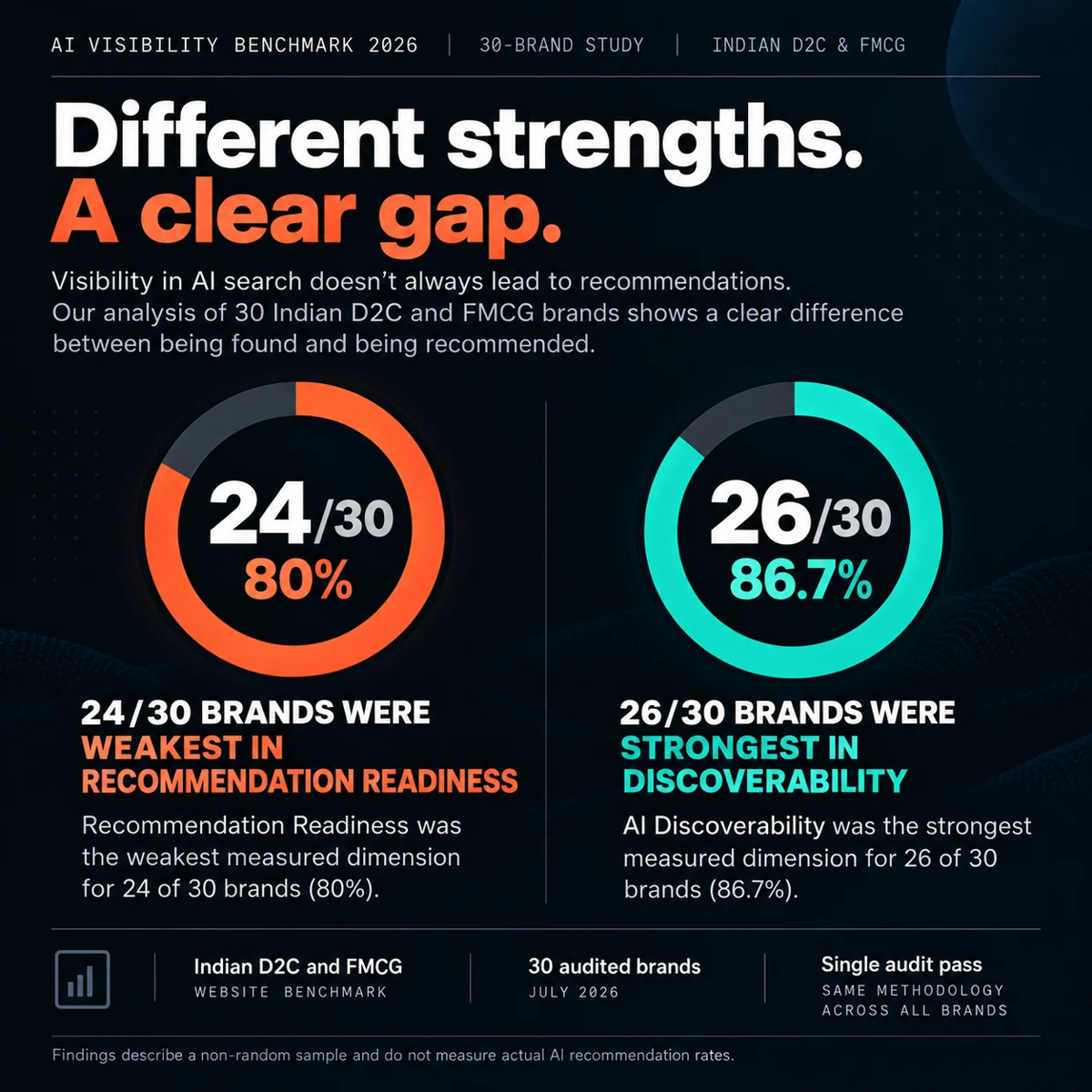
The clearest finding was a difference in relative strengths across the audited websites. Recommendation Readiness was the lowest-scoring dimension for 24 of the 30 brands, or 80%. Discoverability was the highest-scoring dimension for 26 of the 30 brands, or 86.7%.
These numbers refer only to the relative dimension scores of brands in this sample. They do not mean that 80% of Indian brands are ignored by AI systems, nor that 86.7% of businesses appear in AI-generated responses.
The pattern nevertheless points to a practical distinction: a website can make its existence and product catalogue accessible while providing less of the information needed to evaluate suitability. Founders can examine that gap without assuming their website is the sole source an AI system consults.
Why a recommendation needs more context
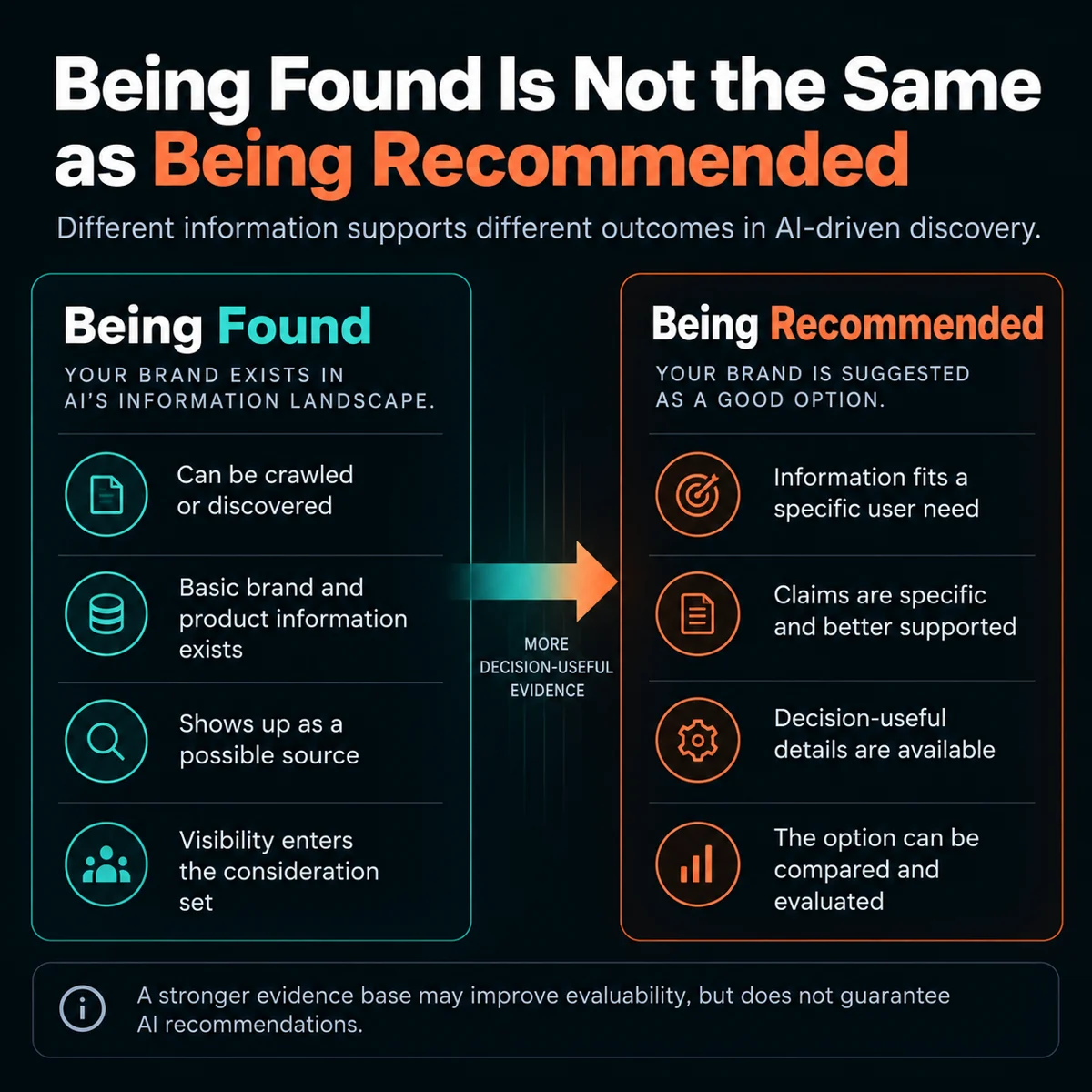
Imagine a customer asking for a lower-sodium snack. A product page that calls a snack “healthy and delicious” does not answer that request. A page with accurate nutrition facts, serving size and sodium content gives the customer information they can check.
For furniture, the decisive details might be dimensions, materials and delivery terms. For a beauty product, they may include ingredients, intended use and relevant warnings. For a service, they might be eligibility, geographical coverage, booking process and charges.
The issue is often not a shortage of marketing copy. It is a shortage of precise, decision-useful facts. Pages written to attract attention can leave real purchasing questions unanswered.
Claims deserve similar care. “Clinically proven,” “best quality” and “most trusted” are not interchangeable with evidence. A factual claim should have an appropriate basis, whether that is a test result, certification, documented policy or other source a reader can inspect. Strong wording alone does not make a claim reliable.
Independent information can add another perspective. Credible reviews, independent coverage and authentic certifications may help someone assess a business beyond its own description. But these should be genuine and accurately represented. Buying flattering endorsements or fabricating reviews undermines the very credibility a business hopes to establish.
A short evidence checklist for small businesses
SyncNeck already offers broader guidance in our AEO and GEO checklist. This narrower checklist focuses on the information gaps suggested by a recommendation-readiness review. Start with one important product or service page.
- Suitability: Does the page say who the product or service is designed for, and mention meaningful limitations?
- Comparison: Can a customer find specifications, ingredients, features or conditions needed to compare options?
- Evidence: Are significant factual claims supported by something the reader can verify?
- Independent context: Is it clear which statements come from the company and which have external support?
- Transaction details: Where relevant, are delivery, warranty, availability, eligibility or returns explained?
The aim is not to satisfy a secret AI formula. It is to remove avoidable uncertainty for real customers. If people repeatedly ask a question your website cannot answer, that is a good place to improve.
Can better information guarantee an AI recommendation?
No. Different AI assistants may use different search integrations, retrieval methods and sources. Their answers can vary with the wording of the question and may change over time. Some responses may use information from marketplaces, review sites or publications rather than a company’s own pages.
A separate evaluation of actual AI mentions and recommendations would require realistic customer questions, repeated tests, clear coding rules and careful handling of variation. The July benchmark did not run that type of controlled outcome study. Its results are best treated as descriptive evidence about a particular set of websites, not as proof that a specific page change increases AI recommendations.
That does not make better product information pointless. Clear and verifiable details can help customers compare options whether they arrive from a search engine, AI assistant, marketplace or referral.
What founders should take away
A business must first be discoverable to have a chance of being considered. But it also needs to explain what it offers and support claims that matter to a buyer.
The 30-brand benchmark found that Discoverability was the strongest measured dimension for most of the audited sites, while Recommendation Readiness was the weakest for most. The finding is limited to that non-random sample and that particular framework, but it gives owners a useful prompt for a practical review.
Open the page for your most important product or service. Pretend you know nothing about the business and have two competing options in front of you. Can you identify who the offering is for, what sets it apart, and which claims can be verified? If not, the missing answers are worth addressing.
Being found creates an opportunity to be considered. Being a credible choice requires information that explains why the choice makes sense.
Related reading on SyncNeck: learn how to get cited by ChatGPT, Gemini and Perplexity, see how AI Overviews are changing Google traffic, and use our GA4 guide to tracking AI traffic. Want help reviewing your own pages? Contact the SyncNeck team.
Research and editorial disclosures
Research affiliation: The non-random 30-brand study included one author-affiliated brand, evaluated under the same framework. The proprietary benchmark was independently funded, was not peer-reviewed and did not measure actual AI recommendation rates.
AI assistance: Generative AI assisted with drafting, structuring and language refinement of this article and preparation of the editorial graphics. Research findings originate from the author’s benchmark; final fact-checking and editorial responsibility remain with the author.
Source: Sarkar, S. (2026). AI Visibility Benchmark 2026, Version 1.1. Digital Platform 271 Research, publication ID DP271-AVB-2026-001, published 19 July 2026.
About the author

Sanchari Sarkar is the founder of Digital Platform 271 and an AI Visibility Consultant based in Kolkata, India. She researches how brands are discovered, understood, cited and evaluated in AI-assisted search.