
For most small-business websites, nothing in Indian law or Google’s rules forces you to stamp “written with AI” on every blog post. What Google does ask is that you’re honest about who wrote a page and how it was made, wherever a reader would reasonably wonder. The simplest way to do that is one short AI policy page, plus a clear label on any realistic AI image, video or voice, because that’s where India’s new rules and ASCI’s ad guidelines actually apply.
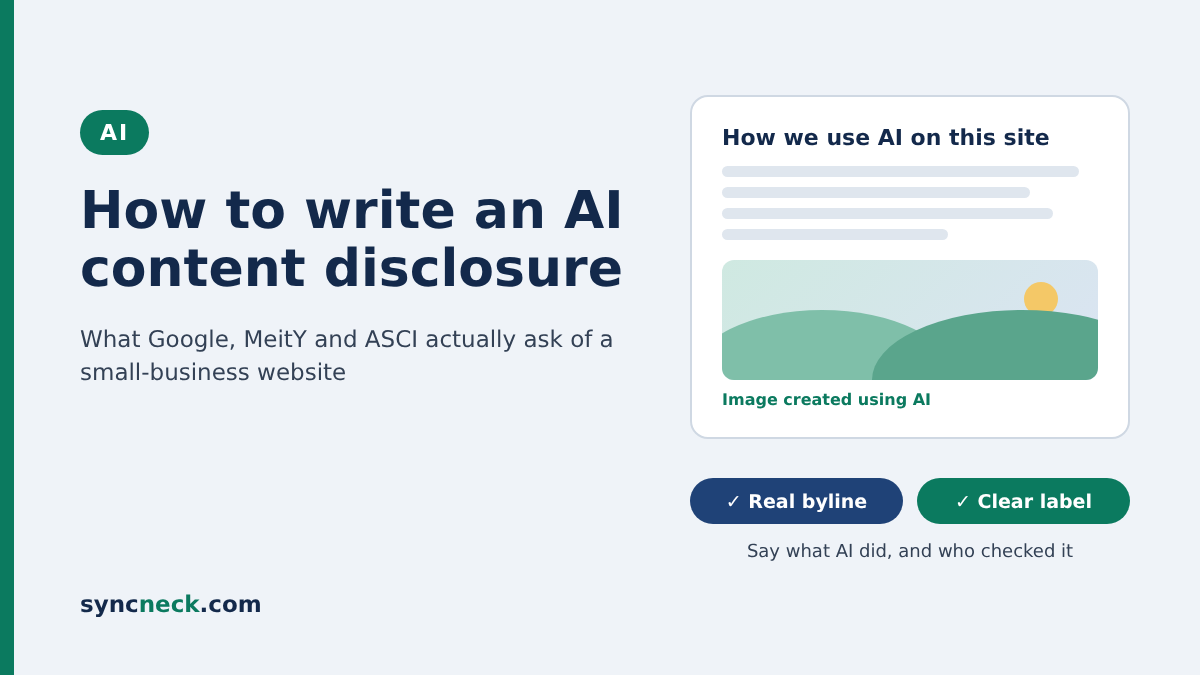
An AI content disclosure is a plain statement telling visitors where AI played a part in what they’re reading or seeing, and where a person stayed in charge. It can be a line under an article, a caption on a photo or a separate page linked from your footer. It doesn’t need legal language. It needs to be true.
What Google actually says
Google’s position hasn’t moved much since 2023. It cares whether content helps people, not whether a person or a model typed it. Its page on creating helpful, people-first content asks site owners to think about “Who, How, and Why”. On the “How” part, it says AI or automation disclosures are useful for content where someone might think “How was this created?”, and suggests adding them when it would be reasonably expected. That’s a recommendation. You won’t find a ranking penalty in Google’s documentation for leaving it out.
Two other points on that same page matter more than the label. The first is bylines. Google strongly encourages accurate authorship information and calls fabricated creator profiles, such as AI-generated headshots, made-up names or false credentials, a form of deception. The second comes from Google’s FAQ on AI-generated content, which says giving AI an author byline is probably not the best way to tell readers AI was involved. So the byline should be the real person who stands behind the piece. The disclosure explains the AI part.
Google’s separate page on using generative AI content now says it’s critical to manually fact-check and review all AI-generated content before publishing, a change Search Engine Land reported on. Keep that in mind, because it decides what your disclosure can honestly claim. The same page notes that sellers face firmer rules: Merchant Center expects AI-generated product images to carry IPTC TrainedAlgorithmicMedia metadata, and AI-written product titles and descriptions to be labelled as AI-generated. We covered the image side in our post on AI-generated product photos.
The Indian rules people mix up
Two separate things happened in India this year, and they often get blended into one scary WhatsApp forward.
The first is the IT (Intermediary Guidelines and Digital Media Ethics Code) Amendment Rules, 2026, notified by MeitY on 10 February and in force from 20 February 2026. They define “synthetically generated information” as audio, visual or audio-visual content that’s artificially or algorithmically created or altered in a way that makes it appear real. The labelling duties sit mainly with intermediaries, meaning platforms and the services people use to make or share such content. In practice, if you upload a realistic AI video to Instagram or YouTube, expect the platform to ask you to declare it. A blog post you drafted with ChatGPT and then rewrote yourself isn’t what these rules target.
The second is ASCI’s Guidelines for Responsible Labelling of Synthetically Generated Content in Advertising, released at the end of September 2026 and, according to Khaitan & Co’s summary, effective three months after publication. ASCI sorts AI use in ads by risk. Some uses are not allowed at all, and a label doesn’t fix them. Others need a disclosure; the consultation draft listed things like virtual influencers, a synthetic version of a real person’s face or voice, AI product demonstrations and realistic AI-made settings. Minor enhancements don’t need a label. Suggested wording includes “Audio/Video created using AI” or “Audio/Video enhanced using AI”, and labels provided by ad platforms count. ASCI also says a correctly labelled ad can still be misleading. The label is not a licence to exaggerate.
YouTube works on similar logic. Its help page on altered or synthetic content requires creators to disclose realistic content that’s been meaningfully altered or generated, doesn’t require it for clearly unrealistic content or minor edits, and says disclosing won’t limit a video’s audience or its eligibility to earn money.
This isn’t legal advice. If you advertise in health, finance or education, have someone qualified look at your actual creatives.
What your disclosure page should cover
Keep it short enough that someone will actually read it on a phone. For a shop, clinic or coaching centre, 200 to 300 words is plenty. Answer these, in this order:
- Where AI helps: drafting blog posts, translating pages into Telugu or Hindi, product descriptions, images, a chat or WhatsApp assistant.
- What it never does on your site, such as giving medical advice, quoting final prices or anything that needs a licence.
- Who checks the output before it goes live, by name or by role.
- How readers can report a mistake, ideally a WhatsApp number or email someone genuinely checks.
- When the page was last updated.
Link it from your footer next to the privacy policy, and from your About page. A single line in the author bio helps too.
A sample, for a clinic that doesn’t exist
Picture a small physiotherapy clinic in Nashik, run by two physios and a receptionist. This is a made-up example. They use ChatGPT for first drafts of blog posts on back pain and knee exercises, Canva’s AI tools for exercise illustrations, and an automated WhatsApp assistant that answers questions about timings and fees and takes a ₹200 UPI advance to hold a slot. Their disclosure page could say something like this:
How we use AI on this website. Some articles here start as AI-assisted drafts. Every article is rewritten and checked by one of our physiotherapists before it’s published, and their name appears on it. The exercise illustrations are AI-generated diagrams, not photos of our patients or our clinic. Our WhatsApp assistant is automated. It can share timings, fees and open slots, but it can’t assess your condition, and it passes anything clinical to our team. Spotted a mistake? Message us on WhatsApp and we’ll fix it. Last updated: November 2026.
Look at what it leaves out. It doesn’t call the AI “expert-trained” or promise content that’s “100% human”. It doesn’t dress the chatbot up as “Priya from reception”. Every sentence is something the clinic could show a patient if asked.
Where labels belong on the page itself
The policy page covers the general picture, but some content needs a label right where people see it. A realistic AI photo of a thali you don’t actually serve, a generated before-and-after image, an AI voice-over that sounds like the owner: each of these deserves a caption on the spot, something like “Image created using AI”. Product listings follow Merchant Center’s own rules, as above.
For a blog post that was AI-assisted but heavily edited, a one-line note at the end works: “Drafted with AI help, reviewed and edited by [name], physiotherapist.” Only write that line if the review really happened.
Decorative stuff, like an abstract AI background behind a Diwali offer banner, usually needs nothing. If nobody could be misled by it, a label just adds clutter.
Do you need a label on every post?
I don’t think so. A banner on every article saying “This content may have been created using AI” trains readers to ignore it, the same way nobody reads cookie notices any more. ASCI’s own press note on the draft talks about avoiding consumer label fatigue for exactly this reason. I’d rather see one honest policy page and specific labels wherever AI changes what a reader would believe.
There’s a cost, and it’s worth being upfront about it. Some readers will trust you a little less once they know AI is involved at all. You can’t fully control that. You can control whether they hear it from you, or catch it themselves later and wonder what else you didn’t mention.
The mistake that does real damage
Forgetting to disclose is rarely the big problem. Overclaiming is. “All content written by medical experts” on a site where half the posts were never reviewed. A made-up author with a stock-photo face and an impressive degree, which Google explicitly lists as deception. If your policy says a person checks everything, then a person has to check everything, including the old posts a freelancer pushed out in bulk two years ago. If that’s not realistic right now, write the policy to match what you actually do, and clean up the old posts over a few weeks.
Where I’d start
Make a quick list of every place AI touches your site: blog drafts, product text, images, the chat widget, translated pages. Write the policy page from that list in plain words. Put a real name on your articles. Then caption any realistic AI image or video. For most small sites that’s an evening’s work, not a project.
If you’re still choosing tools, our guide to testing AI writing tools for your blog pairs well with this. The copyright guide to AI images and music in ads covers the other legal question owners ask, and our explainer on E-E-A-T shows why honest authorship matters for trust. If you’d like help writing a disclosure that fits how your business really works, get in touch with the SyncNeck team.