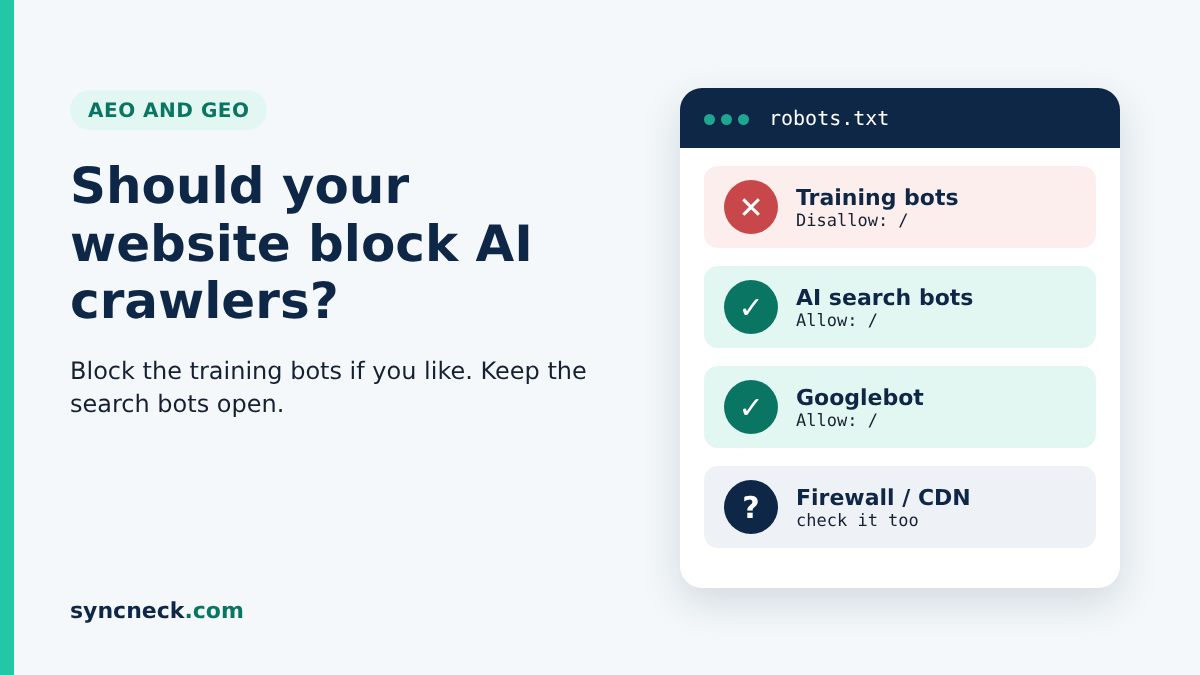
For most small businesses in India, the answer is no, or at least not all of them. Blocking the bots that collect pages for AI training costs you very little. Blocking the bots behind ChatGPT search, Perplexity or Claude’s search answers can quietly take you out of the places where customers now ask for recommendations. And blocking Googlebot to avoid AI Overviews would remove you from Google Search altogether.
There’s a robots.txt snippet that keeps doing the rounds in WhatsApp groups and LinkedIn posts. It lists twenty or thirty AI user agents, puts Disallow: / under each one, and promises to “stop AI stealing your content”. Plenty of owners paste it in without reading the names. Some of those names belong to search tools that send visitors. Before you copy anything, it helps to know which bot does what.
Not every AI bot does the same job
The big AI companies now split their crawlers by purpose. Roughly, they fall into three groups:
- Training bots collect public pages that may be used to train future models: GPTBot (OpenAI), ClaudeBot (Anthropic) and Google-Extended, which is a control token rather than a separate crawler.
- Search bots build the index that AI answers pull links from: OAI-SearchBot, Claude-SearchBot and PerplexityBot.
- User-triggered fetchers visit a page because someone asked the assistant about it right now: ChatGPT-User, Claude-User and Perplexity-User.
Blocking one group doesn’t block the others. That’s the whole point of the split, and it’s why a blanket list is a blunt tool.
What each company says happens when you block
OpenAI is the most direct about it. Its crawler documentation says sites that opt out of OAI-SearchBot won’t be shown in ChatGPT search answers, though they can still appear as navigational links. Disallowing GPTBot, on the other hand, only says your content shouldn’t be used to train its foundation models. OpenAI also notes that robots.txt changes can take about 24 hours to reflect in search, and that ChatGPT-User visits are started by users, so robots.txt rules may not apply to them.
Anthropic’s help page on its bots follows the same pattern. Restricting ClaudeBot signals that your future content should be left out of training data. Turning off Claude-SearchBot stops your pages being indexed for search, which it says may reduce your visibility in Claude’s search results. Anthropic says all its bots honour robots.txt.
Perplexity’s crawler page describes PerplexityBot as a search crawler that isn’t used to train AI foundation models. So if you block it, you’re not protecting anything from training. You’re just leaving Perplexity’s results. Its user-triggered fetcher, Perplexity-User, generally ignores robots.txt because a person asked for the page.
The Google bit most people get wrong
A common mistake is assuming Google-Extended keeps you out of AI Overviews. It doesn’t. Google’s crawler list says Google-Extended controls whether your content may be used to train future Gemini models and for grounding in Gemini Apps and Vertex AI. It has no effect on whether your site is included in Google Search, and it isn’t a ranking signal.
AI Overviews and AI Mode are part of Search. Google’s page on AI features and your website says the controls there are the usual ones: Googlebot access in robots.txt, plus nosnippet, data-nosnippet, max-snippet or noindex on the page. Blocking Googlebot to escape AI Overviews means disappearing from normal results too. For a shop that gets most of its calls from Google, that’s a terrible trade.
There’s also a catch with Google-Extended that most “block AI” lists skip. Google says sites that allow it are eligible to appear in responses and get clicks through grounding in the Gemini app. So disallowing Google-Extended isn’t purely a training decision. It can cost you visibility inside Gemini.
How this can go wrong: a hypothetical Kochi furniture shop
Picture Anitha, who runs a mid-sized furniture showroom in Kochi. Her WordPress site has around 60 product pages: teak dining sets, sofa cum beds, a page on EMI and UPI payment options. Her nephew, trying to help, pastes a “block all AI bots” list into robots.txt after reading that AI companies copy content. The list includes GPTBot and ClaudeBot, which is fine, but also OAI-SearchBot, PerplexityBot and Claude-SearchBot.
Nothing breaks. Google traffic looks normal. But when a couple in Ernakulam ask ChatGPT for “solid wood dining tables in Kochi under ₹40,000”, Anitha’s pages can’t be among the sources, because she has told OpenAI’s search crawler to stay away. She’d never notice. There’s no error message, just referrals that never arrive. If she were tracking AI traffic in GA4, she might spot that chatgpt.com and perplexity.ai never show up, but most owners don’t look.
The fix takes two minutes. Removing three lines.
Where I’d draw the line
For a local business, a clinic or a small online store, I’d keep every search bot and every user-triggered fetcher open. Those are the ones that can send a customer. Googlebot obviously stays open too.
Training bots are genuinely your call, and I don’t think either answer is wrong. My honest view is that blocking GPTBot or ClaudeBot does little harm for a dental clinic in Vijayawada, and also does little good. Nobody’s building a model on the strength of your service page. Blocking also only affects future crawling, not what may already have been collected. If you publish something that is the product itself, like original recipes, paid course notes or research you sell, the argument for blocking training is much stronger, and I’d respect that choice.
Google-Extended is the one I’d think twice about, for the Gemini reason above. If Gemini is where your customers ask questions, leaving it allowed is the safer default.
What a sensible robots.txt looks like
If you decide to block training but stay visible in AI search, a minimal version looks like this. Swap in your own domain:
User-agent: GPTBot
Disallow: /

User-agent: ClaudeBot
Disallow: /

User-agent: *
Allow: /

Sitemap: https://www.yourshop.in/sitemap_index.xml
Everything not named, including Googlebot, OAI-SearchBot, Claude-SearchBot and PerplexityBot, falls under the last group and stays allowed. If you’re happy for your pages to be used in training, you don’t need the first two groups at all. On WordPress, Yoast SEO has a file editor under its Tools menu where you can edit robots.txt, or your developer can upload a plain robots.txt file to the site’s root folder. Either way, open yourdomain/robots.txt in a browser afterwards and read what’s actually being served.
Check the layer above WordPress
This is the part that catches people out. Your robots.txt might be perfect and something else might still be turning bots away. Cloudflare, for example, offers a managed robots.txt that adds Disallow rules for known AI crawlers in front of your own file, and since July 2025 it has asked new domains whether they want to allow or block AI crawlers. Security plugins and hosting firewalls can block by user agent too. Google’s own AI features page lists “crawling is allowed in robots.txt, and by any CDN or hosting infrastructure” as a basic.
A quick audit, once a quarter, is enough for most small sites:
- Open your live robots.txt and search it for OAI-SearchBot, Claude-SearchBot, PerplexityBot and Googlebot. None of them should sit under a
Disallow: /. - If you use Cloudflare, look at its AI crawler and managed robots.txt settings as well as your own file.
- Ask whoever manages your security plugin or hosting whether any bot-blocking rule names AI user agents.
- After any change, give it a day or two before judging. OpenAI mentions roughly 24 hours, and Perplexity says up to 24 hours.
One change coming in 2027
Keeping a list of company-specific bot names is tedious, and the industry knows it. In October 2026, Google announced plans to support a shared AI training preference in robots.txt, based on IETF work, so one line can tell participating AI providers you don’t want your content used for training. Google aims to support it in 2027 and will treat an opt-out as if you had disallowed Google-Extended, unless you name Google-Extended yourself. Anthropic’s help page says it began recognising this kind of signal from 30 October 2026. Company-specific rules keep working alongside it, so there’s nothing to rush. Just know that a simpler option is on the way.
If you’re working on getting cited by AI tools rather than kept out of them, our guide to getting cited by ChatGPT, Gemini and Perplexity is the natural next read, and the AI Mode vs AI Overviews explainer covers the Google side in more depth. If you’d like someone to look over your robots.txt and firewall settings, get in touch with the SyncNeck team.